
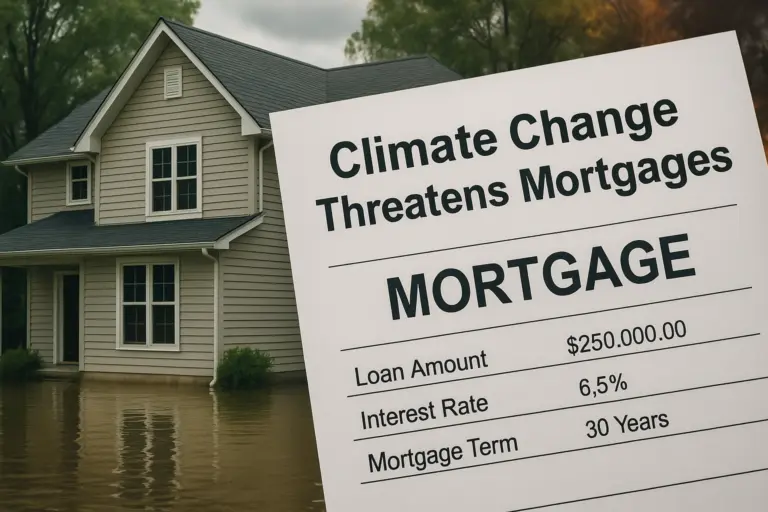
The housing market faces a brand new form of risk in 2025, and it has nothing to do with
rates of interest or affordability. Based on a current report by First Road
Basis, climate-driven disasters are set to drive $1.2 billion in
mortgage credit score losses this 12 months. Uninsured flood and fireplace harm, hovering
insurance coverage premiums, and declining property values may put as many as 19,000 properties
prone to repossession within the subsequent 12 months.
Local weather Disasters and Housing: The Rising Connection
Hurricanes within the Gulf, floods within the Midwest, and wildfires in California are now not
occasional shocks—they’re turning into annual occasions. Because the frequency and depth of pure
disasters develop, the monetary system is being compelled to reckon with dangers that have been as soon as
thought of uncommon.
The Monetary Fallout
- $1.2 billion in projected losses in 2025 from mortgage defaults tied to
local weather disasters. - By 2035, that quantity may swell to $5.4 billion,
with practically 84,000 properties prone to foreclosures or repossession. - Default charges are highest in areas with rising insurance coverage prices and shrinking
protection availability.
For mortgage lenders, insurers, and policymakers, these numbers are a wake-up name.
Why Insurance coverage is the New Mortgage Stress Check
Householders are already fighting increased premiums—property insurance coverage prices rose
**11.3% year-over-year**, the quickest progress of any mortgage expense. However the greater
challenge is availability: in states like California and Florida, main insurers are pulling
out completely, leaving owners uninsured.
For lenders, an uninsured property in a high-risk space is basically unsecured collateral.
If catastrophe strikes, the borrower could stroll away, and the financial institution is left with a devalued or
destroyed asset.
Case Research: Wildfire Danger in California
In California, wildfires are driving insurers out of the market. With out insurance coverage,
conventional banks are scaling again mortgage lending in affected zip codes.
Curiously, some on-line and non-bank lenders are stepping in,
keen to tackle increased dangers in trade for increased charges and costs.
For debtors, this creates a harmful scenario: they could safe financing,
however with out steady insurance coverage, they continue to be susceptible to catastrophic loss.
The Geography of Danger
The report highlights a number of high-risk areas:
- Florida & Gulf Coast: Hurricanes, storm surges, and rising sea ranges.
- California: Wildfires and drought-driven property dangers.
- Midwest: Flood-prone river valleys going through extra frequent inundations.
The Vicious Cycle
Local weather threat feeds right into a self-reinforcing cycle:
- Catastrophe damages properties → house owners can’t rebuild with out insurance coverage.
- Insurers exit markets → premiums skyrocket.
- Debtors default → lenders take losses.
- Property values fall → decreasing tax income and native financial stability.
What’s Forward for Householders and Lenders
Consultants say we’re coming into an period the place local weather threat will likely be as vital as credit score
scores in figuring out mortgage eligibility. By 2030, it could be customary apply for
lenders to issue a property’s flood, wildfire, or storm publicity into the mortgage price itself.
Policymakers are additionally contemplating new backstops, reminiscent of:
- Federal insurance coverage swimming pools for high-risk areas.
- Local weather-adjusted underwriting pointers for mortgages.
- Stricter constructing codes to cut back publicity.
Key Takeaways
- Local weather-driven disasters may trigger **$1.2 billion in mortgage credit score losses in 2025**.
- Insurance coverage is turning into the important thing affordability and lending bottleneck.
- Excessive-risk areas like California, Florida, and the Midwest face the sharpest impacts.
- By 2035, losses may exceed **$5.4 billion**, threatening 84,000 properties.
- Lenders and policymakers should adapt shortly—or threat systemic shocks.
Sources: First Road Basis, ICE Mortgage Monitor, Nationwide Affiliation of Realtors, Bloomberg, Reuters.


